Test the biological rationale for your target
Evaluate the evidence that supports and challenges your target hypothesis with knowing01. Connect relevant public and internal multiomics findings, meaning DNA, RNA and protein measurements, to separate well-supported assumptions from questions that still need experimental validation. Build a transparent target rationale your team can revisit as new evidence arrives.
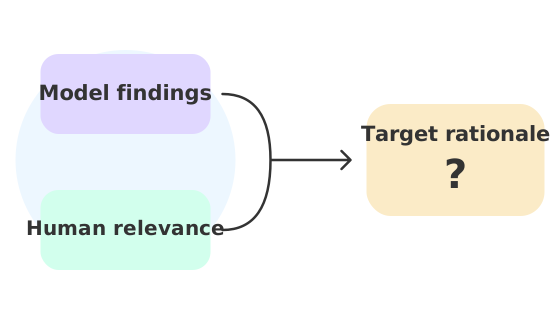
The challenge promising findings with unresolved assumptions
A target can look convincing in one model or dataset while its relevance to human disease is still uncertain. Before the next development step, you need to see the evidence behind the proposed mechanism, including results that contradict it.
When to use this
Use this workflow before you expand a validation program, when experimental results conflict, or when you prepare the biological rationale for clinical development. Start before a weak point in the rationale shapes the next study plan.
The recipe in four steps
Define the hypothesis and criteria
State the target hypothesis, the intended direction of intervention and the criteria that would support or challenge it.
Connect the evidence
Bring together relevant public data and optional internal results. Human disease observations stay separate from findings that only apply to a model.
Challenge the rationale
Check consistency across genetic, expression and other available evidence. Dependent studies are not treated as independent confirmation.
Clarify the next test
Review support, contradictions and uncertainty with your scientific leads. Identify the experiments that resolve the most important open questions.
knowing01 provides
The Data Center to organize relevant public evidence and optional internal results into a data foundation for your target hypothesis, with source assessment.
Automatic linking through Cellmap to connect human and model evidence where available, retaining each finding's source and biological context.
The Evidence Convergence Protocol to guide how you scope the hypothesis, assess supporting and contradictory findings, and document uncertainty and coverage gaps.
Analytics in Contextualize and Explore to retrieve and compare evidence for the proposed mechanism and identify questions for further validation.
You bring
- Target hypothesis and proposed mechanism
- Existing experiments and optional internal data
- Scientific knowledge and the next commitment
Define for this question
- Criteria for supporting or challenging the hypothesis
- A distinction between observed findings and inference
- Priorities for further validation
Outcome and impact
A transparent target rationale
Gain clarity on how strongly the evidence supports your target and where the next experiment matters most. Use findings and visualizations to communicate the rationale, with the evidence foundation accessible in the knowing01 platform.
Target validation analysis supports the biological rationale for IND or EU clinical trial application preparation; it does not replace functional experiments or product-specific studies, or establish regulatory acceptance.
New perspectives Explore evidence that may reveal a previously unconsidered aspect of your target hypothesis or its biological context.
Shared foundation Retain a searchable, team-sharable data foundation scoped to your question, with findings linked to their sources.
Target rationale Clarify which assumptions have support, which depend on causality or model relevance, and which finding would change your decision to progress.