Choose which genes, proteins and variants to investigate next
Compare your candidate genes, proteins, variants or genomic positions across public and internal datasets with knowing01 to decide which warrant experimental follow-up. Build a transparent rationale for your shortlist that you can revisit as the evidence grows.
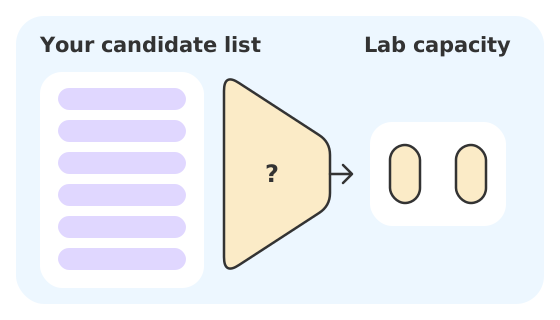
The challenge A long candidate list and limited lab capacity
Your omics analysis can leave you with a long list of candidates and limited lab capacity to test them. Comparing your candidates across datasets by hand is slow, because each dataset may use different names and codes for the same gene, protein or variant. You also need to distinguish a one-study finding from a repeated disease signal.
When to use this
Use this workflow after your initial omics analysis and before you select marker candidates for follow-up experiments. At that point, you can still direct your assay resources to the best-supported candidates.
The recipe in four steps
Define the candidates and criteria
Set your intended research use, disease context and evaluation criteria, and upload your candidate lists.
Connect the evidence
Add public and internal data. Cellmap, the knowledge graph inside the knowing01 platform, links the different identifiers for each gene, protein or variant across datasets, including human, mouse and rat data, and keeps each finding's source.
Evaluate the candidates
In the Contextualize and Explore views, check evidence coverage, overlaps between datasets and significance thresholds. Assess each candidate criterion by criterion, including direction of change, consistency and study relevance.
Generate the shortlist
Pick your shortlist, note where evidence conflicts and which results would change it, and update it as new findings arrive.
knowing01 provides
The Data Center to build, organize and update your data foundation with relevant studies, datasets and candidate lists.
Automatic linking through Cellmap, connecting identifiers across datasets while keeping each finding linked to its source.
The Evidence Convergence Protocol to guide how you scope your question, evaluate the evidence and document your conclusions.
Analytics in Contextualize and Explore to retrieve evidence, compare candidates and analyze shared or distinct signals across datasets.
You bring
- Research question, candidate lists and evaluation criteria
- Public and internal datasets and scientific context
- Scientific priorities and judgment to interpret the findings
Outcome and impact
Clear priorities for your next experiments
Take an evidence-based shortlist into the lab, with a clear rationale for what to test next. This can help you focus your experiments and avoid the cost of advancing poorly supported candidates. Experimental validation remains essential; prioritization alone does not establish regulatory biomarker qualification.
New perspectives
Explore evidence that may reveal previously unconsidered marker candidates, biological connections or reasons to revisit your shortlist.
Shared foundation
Retain a searchable, team-sharable data foundation scoped to your question, with findings linked to their sources.
Clear priorities
Prioritize candidates against your criteria, with repeated signals, conflicting findings and coverage gaps visible in the rationale for your next experiments.