Put your disease markers into biological context
Connect disease-related genes, proteins, variants and pathways with knowing01 across public and internal datasets. Explore where findings agree or differ, which biological processes they point to and what still needs investigation. Build an interpretation you can explain and revisit as the evidence grows.
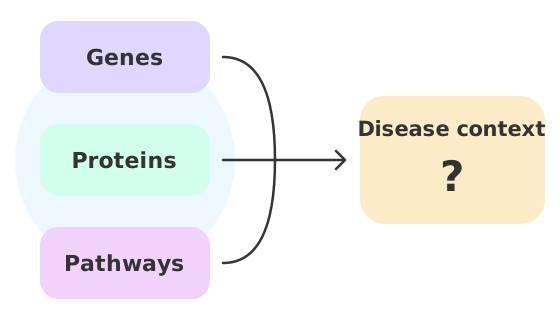
The challenge Separate findings, an incomplete biological picture
Your analysis may link a gene, protein, variant or pathway to a disease without explaining how the findings fit together. Different identifiers, omics layers and biological settings can make related observations difficult to compare. You need to understand whether a pattern recurs in relevant evidence, depends on a particular study or remains unresolved.
When to use this
Use this workflow when you have disease-related molecular findings and need to understand their wider biological context. Start before you turn an association into a target hypothesis or commit to a follow-up experiment, while additional evidence can still shape what you investigate.
The recipe in four steps
Define the disease question and criteria
Specify the disease, tissue or cell type you want to investigate and the molecular findings you need to understand. Set the criteria you will use to assess relevance, including which biological settings and types of evidence can inform your question.
Connect the evidence
Bring relevant public and internal datasets into your data foundation. Cellmap links identifiers across the selected evidence so you can follow related genes, proteins, variants, genomic positions and pathways across human, mouse and rat data while retaining the source and biological setting of each observation.
Evaluate your markers
Use Contextualize to retrieve evidence around your markers and Explore to examine what datasets share and where they differ. Review direction of change, thresholds and study relevance, keeping contradictory findings and gaps in coverage visible.
Generate and record your interpretation
Document which biological interpretations the evidence supports, which depend on assumptions and what a follow-up experiment could clarify. Save your input and result lists so you can revisit the same question as new findings become available.
knowing01 provides
The Data Center to organize and update a data foundation scoped to your disease question, with relevant studies, datasets and input lists.
Automatic linking through Cellmap, connecting molecular identifiers across datasets and omics layers while preserving each finding's source.
The Evidence Convergence Protocol to structure how you define your question, evaluate the evidence and record your interpretation.
Analytics in Contextualize and Explore to retrieve linked observations, compare datasets and examine shared or distinct molecular patterns.
You bring
- Your disease question and the genes, proteins, variants or other molecular findings you want to investigate
- Relevant public and internal datasets and your understanding of the biological setting
- Evaluation criteria and scientific judgment to interpret the linked evidence
Outcome and impact
A clearer explanation of your disease-related findings
Take forward an interpretation that connects your markers to the relevant biological context, with the supporting evidence and open questions visible. Use it to frame the next hypothesis or experiment. Linked associations do not establish that a marker causes disease or is a suitable therapeutic target; those hypotheses need further experimental investigation.
New perspectives Explore connections between markers, pathways and disease biology that you may not previously have considered.
Shared foundation Retain a searchable, team-sharable data foundation scoped to your question, with findings linked to their sources.
Biological context Understand how your genes, proteins, variants and pathways relate to your disease question, distinguishing recurring observations from contradictions and gaps in coverage.