Choose your next indication with a clearer biological rationale
Compare candidate indications for your existing target or program with knowing01. Connect multiomics evidence, define evaluation criteria and interpret the findings in your scientific context. Explain which indications warrant further development and why.
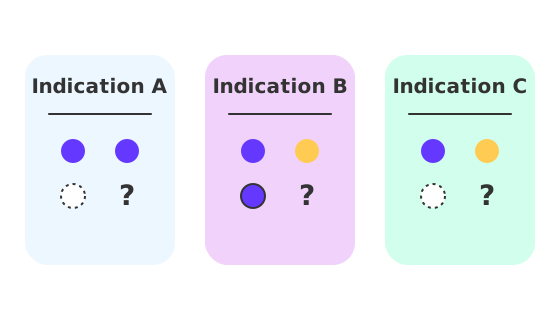
The challenge competing indications with uneven evidence
A strong signal in one disease can be hard to compare with broader but less specific evidence in another. A preference for one indication may reflect real biological support, or simply which data exist and which assumptions nobody has tested.
When to use this
Use this workflow before you select a lead or backup indication, prepare a program review or revisit priorities during IND or EU clinical trial application planning. Start before the next indication-specific study is committed, while the evidence can still shape the strategy.
The recipe in four steps
Define the comparison and criteria
Define the target or mechanism, the candidate indications and the evaluation criteria, and set the scope and timing.
Connect the evidence
Bring together relevant public datasets and optional internal findings, keeping the disease, patient cohort and cell-type context of each result.
Compare against criteria
Evaluate support, contradictions and missing evidence for each indication, and check whether differences reflect biology or uneven data coverage.
Inform the decision
Interpret the comparison with your scientific leads. Identify what would justify progressing an indication or changing its priority.
knowing01 provides
The Data Center to organize relevant public datasets and optional internal findings into a data foundation for your indication comparison, with source assessment.
Automatic linking through Cellmap to connect evidence while retaining the disease, patient cohort and cell-type context of each result.
The Evidence Convergence Protocol to guide scoping, comparison criteria and interpretation, keeping supporting, conflicting and missing evidence visible.
Analytics in Contextualize and Explore to retrieve and compare evidence across candidate indications, with links to the underlying sources.
You bring
- Target, proposed mechanism and candidate indications
- Program context and scientific knowledge
- Existing findings and optional internal datasets
Define for this question
- The indication question and comparison criteria
- A feasible scope and timing matched to the decision
- Interpretation, priorities and questions to resolve next
Outcome and impact
A transparent biological rationale
Build a transparent biological rationale for your lead and backup strategy, with uncertainties and differing judgments visible. Your team can revisit that rationale in the knowing01 platform as evidence and questions evolve.
Indication prioritization supports the biological rationale behind the indication strategy; it does not cover clinical or commercial considerations, and the trial sponsor keeps responsibility for development decisions, experimental validation and submission content.
New perspectives Explore evidence that may reveal previously unconsidered indications, biological links or reasons to revisit your priorities.
Shared foundation Retain a searchable, team-sharable data foundation scoped to your question, with findings linked to their sources.
Indication priorities Compare biological support against your criteria, with contradictions and missing evidence visible, to identify what to investigate before the next development phase.