A modular data foundation for fit-for-purpose evidence
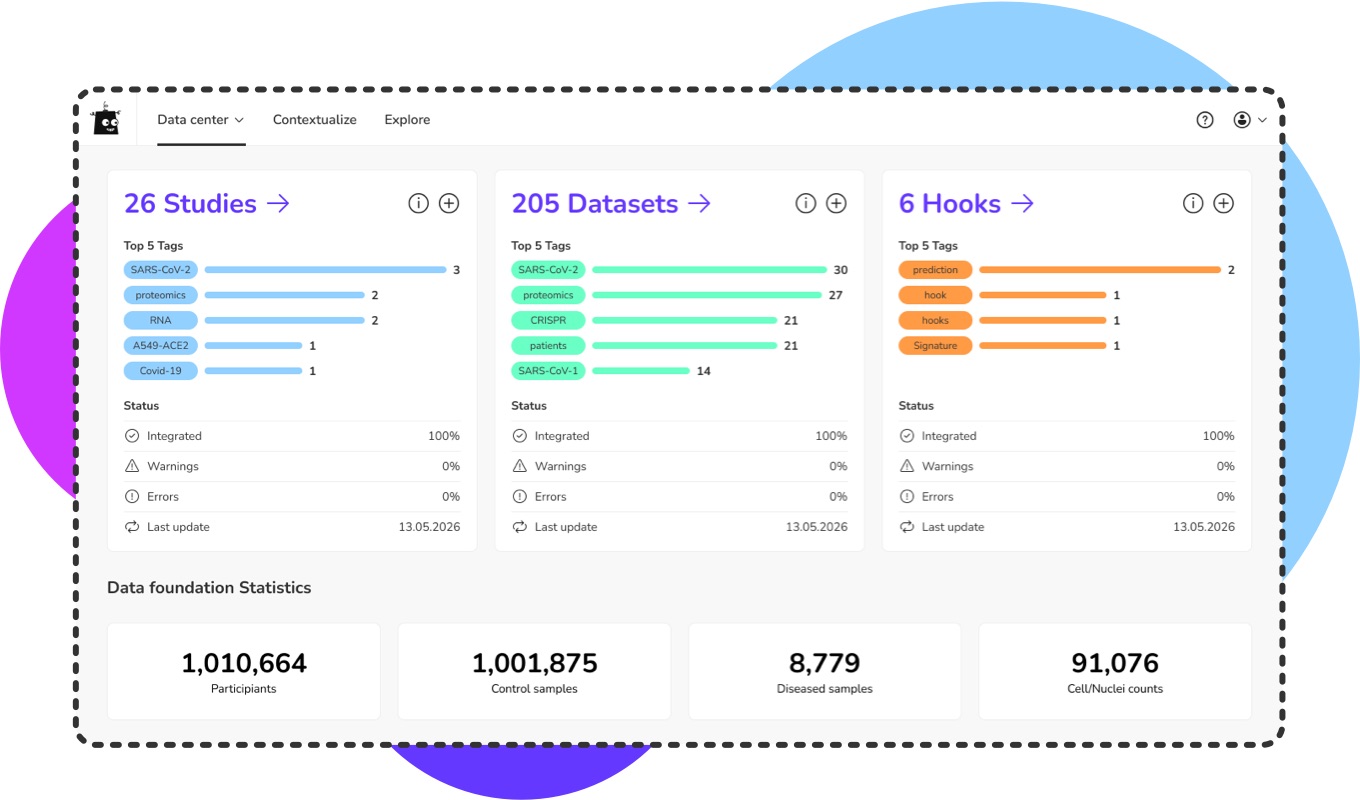
The evidence you need is out there, buried in thousands of studies in formats not compatible with each other. We turn it into a flexible evidence base, on its own or with your own data, built and expanded within weeks, not months or years, as your question evolves from discovery to clinic.
At a glance
300+ datasets collected, prepared and
harmonized within ~1 weekMulti-species homology data linked
automatically500 → 5,000 patient coverage by tapping
into public data
What our clients say
Access to this scale of unbiased Multiomics data was a game changer for us. For the first time, we could systematically explore biology across more than 30 immunology and inflammation (I&I) indications, something simply out of reach with traditional approaches. This gave us an entirely new level of confidence in where and how to focus our efforts. Along the way, we uncovered patterns that reshaped how we think about the underlying biological processes.

A living evidence base, not a one-off pull of data
Flexible by design
The foundation is modular and updatable. Some teams bring a large share of their own private data, others rely mostly on curated public Multomics data, and most fall somewhere in between. Whatever the mix, for each project we assemble a decision-ready dataset from public sources, your private data or a combination of both, stored in a shared data foundation rather than in parallel silos.
There, everything is standardized into consistent entities and can be traced back to its source. From there, the data is ready for analysis of the questions driving a program, centered around targets, indications or modalities.
You set the scope according to your research focus and keep adding to it. Expanding the context refines the results rather than compromising them.
Gradually add Omics layers
Start with what you have. A new Omics layer, a new study or a larger cohort joins the existing links instead of creating a new silo.
Genetics, epigenetics, transcriptomics, proteomics through to metabolomics, along with their combinations, all end up in the same data foundation and can be queried together.
Coverage becomes denser. Every layer you add deepens the context around the markers you’re already interested in or discovering for the first time.
Data foundation in action
You provide a marker list, a target or an indication. Contextualize on our knowing01 platform retrieves all the information the data foundation holds across all Omics layers and provides it as a view ranked by relevance, so you can grasp the complete Multiomics picture for your markers at a glance.
Coverage you can see. How much evidence supports a marker, across which datasets, cohorts and species, and where does it thin out.
Overlaps between datasets, on demand. Link and combine datasets to see where a signal repeats and where it doesn’t, with the linking handled consistently in the background.
Every number is traceable to its source. A coverage figure leads to the exact datasets behind it, with quality signals attached. It’s a number you can defend.
Novel signals versus background noise. The foundation shows which markers are unique to your data and which appear almost everywhere, so you can focus on the ones that really matter.
Triage before you commit

Check if it's real, fast
Before you invest in an in-depth analysis, try triage first. Take a marker gene list and check its presence, strength and consistency across a set of reference datasets to answer one question: Is there a credible, reproducible signal elsewhere, or not? Some teams cut the time for these checks from several weeks to just a few days.
Search across species
A weak human signal won’t hold you back. Our Cellmap technology resolves homologies between species, allowing you to compare model organisms within the same context rather than treating each species separately. For example, if human, mouse and rat data are linked today, additional organisms can be added later as needed.
Provenance and quality control
Original files are preserved in their original format. Each linked observation can be traced back to its dataset and study, including thresholds and the model used, so that a result can always be followed back to its source and justified.
Questions we hear
We already have a data lake. How is this different?
A data lake is used to store data. This, however, is a modular, linked foundation designed for evidence coverage and search across modalities, cohorts and species, with curated sources and consistent normalization. The added value lies in the linking and coverage, not in the storage.
Public datasets are not always reliable. How do you handle that?
We focus on curated sources and quality checks and ensure transparent provenance, so your team can trust and defend the data used, rather than simply accepting it blindly. Every observation can be traced back to its dataset and study.
Can we contribute our own private data to the foundation?
Yes. Private study and clinical data can be added to the public foundation under finely tuned access controls, quality assurance protocols and anonymization guidelines. Most teams use a mix of public and private data, and you set this balance to fit your program.
What happens when new evidence arises? Do we rebuild everything?
No. A new dataset joins the existing links rather than triggering a full re-integration. Expanding the context refines the results rather than destroying what already exists.
Do you have pre-made indication maps?
To some extent, yes. We start from a solid foundation rather than a blank sheet of paper, but every foundation is tailored individually to your program, its modalities, cohorts and the decision you’re working toward. You benefit from the speed of reusable components whose scope is precisely tailored to your specific research, not from a generic map.
How long does it take to build the data foundation?
Most of the time is spent on the concept, not on the technical implementation: It’s about agreeing on which data will actually answer your research question. Once this is determined, the data is consolidated and harmonized into a fit-for-purpose analysis using our proprietary AI-enabled technology, a process that typically takes only a few days.
How quickly can we iterate once it is running?
Fast. Add or remove data, and you can see the impact on your results the very same day, since new data is linked to the existing data rather than triggering a rebuild.